Get Updated

Traders Trade

Saturday, September 13, 2008

Malaysia's Anwar leads criticism of government crackdown

Malaysian opposition leader Anwar Ibrahim on Saturday led demands for the government to end a crackdown that saw the arrests of an opposition politician, a blogger and a journalist.

The arrests on Friday under tough internal security laws raised fears that the ruling Barisan Nasional coalition will launch a widespread campaign against dissent as it faces an opposition bid to seize power within days.

Rights groups have condemned the use of the Internal Security Act (ISA), which allows for indefinite detention without trial, and the United States summoned Malaysia's top envoy in Washington in protest.

Anwar, who is trying to sign up enough defecting lawmakers to topple the government, said it was running scared after March general elections that handed his opposition alliance unprecedented gains.

"Instead of pursuing a reform agenda it has chosen to burn the country to save itself and to maintain its odious grip on power," he said in a statement.

The three arrested have been accused of inciting ethnic tensions in the multicultural country, but Anwar accused the government of stirring up a phony racial crisis in order to deflect attention from its own problems.

"We ask the government how far it is willing to go to usurp justice and destroy the institutions of good governance in its attempt to drive the Malaysian people against each other," he said.

Anwar insisted he has the support to seize power, but indicated that the timing of his parliamentary coup, slated for next Tuesday, could be affected by the ruckus.

"The priority is political stability. It's not an issue of deferring, we have the numbers to move," he told a press conference, adding he was "mindful" that he too could be targeted with arrest.

Home Minister Syed Hamid Albar denied the detention sweep was aimed at suppressing dissent and said the police had moved to secure public order as tensions rose and people started to hoard food.

"This country is multiracial and their relations can be fragile," he told a press conference. "If the police feel public order is under threat or possible conflict could occur in the country, they will take preventive action."

Syed Hamid said that the journalist, 32-year-old Tan Hoon Cheng from the Chinese-language Sin Chew Daily News in northern Penang state, was released Saturday afternoon.

"She is not a security threat," he said, adding that one of the reasons she was taken into custody was because "we received reports her life was threatened."

Tan was thrust into the national spotlight after reporting on an outburst from a ruling party member who called ethnic Chinese "squatters" and was disciplined by the ruling party which represents Muslim Malays.

The arrest drew rare condemnation from the Malaysian Chinese Association, the second-largest political party in the Barisan Nasional, which said the ISA may need to be abolished.

"MCA is dismayed, disappointed and shocked with the ISA detention of Tan Hoon Cheng," said Ng Yen Yen, head of the MCA's women's wing.

Syed Hamid said investigations would continue into the other two detainees and "if there is no reason to hold them they will be released within 60 days."

Opposition lawmaker Teresa Kok, 43, from the Chinese-based Democratic Action Party, a member of Anwar's opposition alliance, was arrested over allegations that she complained about the noise of morning prayers at a mosque.

She has said the accusation is "preposterous".

The third detainee is Malaysia's leading blogger, 58-year-old Raja Petra Kamaruddin, who has repeatedly targeted government figures on his website "Malaysia Today".

He has already been charged with sedition and defamation after linking Deputy Prime Minister Najib Razak and his wife to the sensational murder of a Mongolian woman.

Three Malaysian newspapers -- Tan's Sin Chew Daily News, The Sun, a free English-language daily, and Suara Keadilan, which is published by the opposition -- were also Friday threatened with suspension.

"This, together with the arrest of Raja Petra under the ISA, may be viewed as a chilling message that our fundamental freedoms are not secure," said Ambiga Sreenevasan of Malaysia's Bar Council.

1 out of 5 phschological traps

It has been very long since the last posting due to some problems I face.

Today i will be talking about the 5 psychological traps and how to aviod them with rational decision-making.

I will only be talking 1of the traps each day, so lets get started with the 1 trap which is Fears of Regret and Loss Aversion.

According to behaviourists, most investors tend to postpone selling losing stocks in order not to finalise errors that have been made. Not to mention it always happens to me. This is due to the fear of regret and loss aversion. The fear of regret can also occur when investors miss out on a stock that appriciates in value. To avoid the possibility of feeling this regret, these investors tend to acquire only stocks that are popular. Behavioural finance experts also find that investors are much less embarrassed about losing money on favoured stocks than from losing money on an unknwon or unpopular share.

The loss-aversion theory states that people experience different degress of emotion when gains and losses are made. A loss alsways appear larger than a gain of an equivalent size and this is why investors may choose to hold on to their losing stocks and sell their winners. This is also the reason investors often take on more risks to avoid making loss, prefering to hold on onto their losing investments in the hope that the price will recover. Gamblers on a losing streak exhibit this loss-aversion tendency, doubling up bets in a bid to recoup what they had already lost.

WHAT TO DO??

  1. As a lot of money has been lost by holding on to a stock that is not appreciating in value, investing professionals advise investors to decide ahead of time which investment should be sold if it drops to a certain level during a market correction. A sudden drop in the stock market is not the time to be sorting out your portfolio. You want to treat any pullback as an opportunity to increase holdings of your favorite stock.
  2. To prevent impulsive selling of securities that have made losses in order to avoid making a begger loss, investors should check if the fundamentals of the asset have changed. Advice to exit an investment, asset class or market, can be based on a market view or asset allocation reason. For example, switching the gains made by bonds to stocks tha t have not performed is to rebalanceyour portfolio. However, if bond fund have lost value due to the rising default risk, existing bonds and increasing equity exposure is due to a change in the fundamentals of the bond asset class.
  3. Investors should also practice setting stop-loss orders before their investments. Think about you much you can afford to lose. Be disciplined if the stocks price does depreciate and sell at the point that you have planned.

Friday, June 13, 2008

For your knowledge.......amazing homework....

Last Friday Tenaga stock rose by about MYR1.00. Volume traded in excess of 35 million units. Tenaga stock was suspended on Thursday.

Put these points together.

1. If you know that an announcement would be made on Thursday that TNB rates will be revised upwards you would surely buy Tenaga shares on Tuesday.
2. If you own an investment bank or have sufficient credit line with an Investment Bank you would have bought as much as you could knowing that the price will surely go up.
3. Since you have to pay within 3 days (T+3 rule), you would have planned to sell on Friday. Â So you could have bought 1Million Tenaga shares on Tuesday and sold it today for a cool MYR1Million profit without paying any money (perhaps some borrowing costs for 2-3 days).
4. Of course none of us are privy to the announcement of the fuel hike, but the family of the PM are privy to it.
5. Of course none of us have a large credit line with an Investment Bank but the family of the PM owns an investment bank.
6. Why the surprise announcement on 05 June when the PM has said that it would be in August ? Well you can only make a big and quick profit if you control the timings and surprise others.
7. For those in the know (the powers that be and their cronies) this has been one hugely profitable week buying and shorting the related shares. The poor rakyat had to queue just to fill up their tanks and perhaps save between MYR20-MYR100.


Now read below..... Need those in know of the basic economics of crude, fuel etc to comment.

WHAT IS NEVER MENTIONED IN Mainstream Media like NST/TheStar/ Utusan/BH are these facts....

Malaysian PerCapita Income USD 5000 VS
Singaporean PerCapita Income USD 25000

Further The Star made a comparison of prices in Thailand , Singapore and Indonesia .For Thailand it is quoted at RM3.90/liter, however are they aware that in Thailand new cars are cheaper than Malaysia by RM10,000? They pay only one life time for their driving license? No renewal fee after that? Also that goes for road tax as well? And do TheStar also aware that you can drive all the way from Hadtyai to Bangkok on a six lane highway without paying any Tolls ??!!

Whereas here in Malaysia you have to pay yearly renewal for road tax , driving license and TOLLS, TOLLS, TOLLS!!!

For Singapore how can you quote RM 5.20 ? Please quote in Singapore Dollars because they are earning in Sing Dollars. You might as well say Europeans are paying RM10/liter. RM5.20/liter = Sing $ 2.20/liter, still cheaper than Malaysia in view of fact that Singapore is not a crude oil exporter. Are you saying that you fill up petrol in Singapore by paying Ringgit?

In economy, dollar to dollar must be compared as apple to apple. Not comparing like durian in M'sia is much cheaper than durian in Japan !! Of course-lah, Japan is not durian producer!!! Comparing Malaysian durian with Thailand durian make more sense!!

For Indonesia we might say is cheaper there at RM2.07/liter but compare that to their level of income!


Now, let us compare the price with OIL PRODUCING countries:

UAE RM1.19/litre
Eygpt RM1.03/litre
Bahrain RM0.87/litre
Qatar RM0.68/litre
Kuwait RM0.67/litre
Saudi Arabia RM0.38/litre
IranRM0.35/litre
Nigeria RM0.32/litre
Turkmenistan RM0.25/litre
Venezuela RM0.16/litre
MALAYSIA RM2.70/litre


RM 2.70!!! Individual perspective:

As of last month a Toyota Vios would 'cause a damage' of about RM 89,000.In the international market, a Toyota Vios is about USD 19,000USD 19,000 = RM 62,700 (using the indicative rates of USD 1 = RM 3.30)That makes Malaysian Vios owners pay an extra RM 26,300.

This RM 26,300 should be cost of operations, profit and tax because the transportation costs have been factored in to the USD 19,000.

RM 26,300/ RM625 petrol rebate per year translates to a Vios being used for 42.08 years.

I do understand that the RM 625 is a rebate given by the government, but it also means that one has to use the Vios for 42.08 years just to make back the amount paid in taxes for the usage of a foreign car. Would anyone use any kind of car for that long?

Now with these numbers in front of us, does the subsidy sound like a subsidy or does it sound like a penalty? This just seems to be a heavy increment in our daily cost of living as we are not only charged with high car taxes but also with a drastic increase in fuel price.

With all the numbers listed out, I urge all Malaysians to join me in analyzing the situation further.

Car taxation is government profit, fuel sales is Petronas' (GLC) profit which also translates into government profit. The government may ridicule us Malaysians by saying look at the world market and fuel price world wide. Please, we are Malaysians, we fought of the British, had a
international port in the early centuries (Malacca), home to a racially mixed nation and WE ARE NOT STUPID!!!

We know the international rates are above the USD 130/barrel. We understand the fact that the fuel prices are increasing worldwide and we also know that major scientist are still contradicting on why this phenomenon is happening. Some blame Bush and his plunders around the world and some blame climate change and there are others which say petroleum 'wells' are getting scarce.

Again we go back to numbers to be more straight fwd

1 barrel = 159 liters x RM2.70/liter = RM 429 or USD 134

On 1 hand, we are paying the full cost of 1 barrel of crude oil with RM2.70 per liter but on the other hand the crude oil only produces 46% of fuel.

Msia sells crude oil per barrel at USD130 buys back Fuel per barrel at USD134. And not forgetting, every barrel of fuel is produced with 2 barrels of crude oil.

1 barrel crude oil = produce 46% fuel (or half of crude oil), therefore 2 barrel crude oil = approximately 1 barrel fuel. In other words, each time we sell 2 barrels of crude oil, equivalently we will buy back 1 barrel of fuel.

Financially, Malaysia sell 2 barrel crude oil @ USD 130/barrel = USD 260 = RM 858 then, Malaysia will buy back fuel @ USD 134/barrel = RM 442/barrel. Thus, Malaysia earn net extra USD 126 = RM 416 for each 2 barrel of crude sold/exported vs imported 1 barrel of fuel !!!(USD 260-134 = USD 126 = RM416)

So where this extra USD 126/barrel income is channeled to by Malaysian Govt???????? ?

Another analysis:

1 barrel crude oil = 159 liters. 46-47% of a barrel of crude oil = fuel that we use in our vehicles.
46% of 159 = 73.14 liters. @ RM 2.70/liter x 73.14 liter = RM197.48 of fuel per barrel of crude oil. This is only 46% of the barrel, mind you. Using RM 3.30 = USD 1, we get that a barrel of crude oil produces USD 59.84 worth of petrol fuel (46% of 1barrel). USD 59.84 of USD 130/barrel turns out to be 46% of a barrel as well.

Another 54% = bitumen, kerosene, and natural gases and so many more. And this makes a balance of USD 70.16 that has not been accounted for.

So this is where I got curious. Where is the subsidy if we are paying 46% of the price of a barrel of crude oil when the production of petrol/barrel of crude oil is still only 46%?

In actual fact, we still pay for this as they are charged in the forms of fuel surcharge by airlines and road taxes for the building of road (because they use the tar/bitumen) and many more excuse charging us but let us just leave all that out of our calculations.

As far as I know, only the politicians who live in Putrajaya and come for their Parliament meetings in Kuala Lumpur (approximately 60+ km) are the ones to gain as they claim their fuel and toll charges from the money of the RAKYAT's TAX.

It is so disappointing to see this happen time and time again to the Malaysian public, where they are deceived by the propaganda held by the politicians and the controls they have over the press.

Which stupid idiot economist equates rebates for rich or poor with the cc of the vehicles? An average office clerk may own a second hand 1300cc proton Iswara costing $7,000 (rebate = $625) while the Datuk's children can own a fleet of 10 new cars of BMW, Audi and Volvo all less than 2000cc costing $2 millions and get a total rebate of $625 x 10 = $6,250! Wow what kind of economists we are keeping in Malaysia ...wonder which phD certificate that they bought from...

Misleading concept of Subsidy:

The word "subsidy" has been brandished by the BN government as if it has so generously helped the rakyat and in doing so incurred losses. This simple example will help to explain the fallacy:

Example:
Ahmad is a fisherman. He sells a fish to you at $10 which is below the market value of $15. Let's assume that he caught the fish from the abundance of the sea at little or no cost. Ahmad claims that since the market value of the fish is $15 and he sold you the fish for $10, he had subsidised you $5 and therefore made a loss of $5.

Question : Did Ahmad actually make a profit of $10 or loss of $5 which he claimed is the subsidy?

Answer:
Ahmad makes a profit of $10 which is the difference of the selling price ($10) minus the cost price ($0 since the fish was caught from the abundance of the sea). There is no subsidy as claimed by Ahmad.


The BN government claims that it is a subsidy because the oil is kept and treated as somebody else's property (you know who). By right, the oil belongs to all citizens of the country and the government is a trustee for the citizens. So as in the above simple example, the BN government cannot claim that it has subsidised the citizen!

Wednesday, June 4, 2008

Fuel Price Hike

With no end in sight to high world oil prices, India and Malaysia on Wednesday became the latest Asian countries to risk the wrath of voters by raising the price of subsidized fuel, a highly unpopular measure that could further weaken the governments of both countries made fragile by recent electoral setbacks.

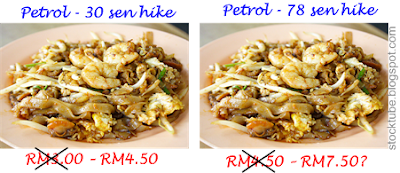
Fuel hike char kuey teowIt would be super interesting to see how the government is going to tackle the inflation this time. If a plate of char-kuey-teow could skyrocketed from RM3.00 to RM4.50 during the last 30 sen a liter hike, I suppose the same plate of noodle will costs RM7.50 soon – that is if you’re lucky. Why the government has this funny hobby of watching people rushing to the petrol stations to fill up their tanks, late into the night? Simply puzzling! And to those voters who voted the BN (National Front) – Congratulations!!!

Anwar Ibrahim, the head of the largest opposition party and a former finance minister, said he feared that the billions of dollars the government will save by cutting subsidies would be wasted.

In the past, he said, Malaysia's oil revenues were "disbursed for megaprojects and projects that benefit the rich and the cronies."

"People can be persuaded to accept the gradual reduction of subsidies," Anwar said by telephone from his home in Kuala Lumpur. "But not when the funds are not disbursed in a transparent manner."


Tuesday, April 1, 2008

CPO is violating its uptrend line

At the end of the morning session today, CPO closed at RM3078 per tonne. At that price, CPO has broken below its medium-term uptrend line support at RM3300. In fact, it is lower than the low of RM3200 recorded last week (see Chart 1 & 2 below). A quick recovery above the RM3300 is important, failing which the current CPO's uptrend is deemed over.

Saturday, March 29, 2008

KLCI : Challenging Massive Gap

Both the S&P 500 and NASDAQ still managed to keep their heads above water despite consumer confidence index checked in well below market expectation. Besides, our market also reacted positively to the news from Invest Malaysia. The KLCI is now entering the massive “Downside Gap” created on 10 March 2008. It will not be easy for the bulls at the gap area. Although we are now eyeing the near-term market with bullish eyes, we still want to warn ahead that there is still a possibility the market could consolidate sideways within a wide zone ranging from the 1157 pts level to the 1243 pts level. Note that the key index only eked out from the 1143 pts level by 2.42 pts.

Immediate resistance for the market remains at the 1243-1296 pts area. To the downside,continue to look for an immediate support at the 1200 pts level followed by the 1157 pts level.

Monday, March 17, 2008

JPMorgan to Buy Bear for $2 a Share

With a deal finally struck, JPMorgan Chase & Co. will embark on the tough task of absorbing Bear Stearns Cos., once among its biggest rivals on Wall Street.

As the assimilation proceeds, the financial industry wants to know exactly how badly Bear Stearns bet on mortgage-backed investments. Unwinding the nation's fifth-biggest investment houses should provide some insight into what other financial institutions might have on their books.

JPMorgan's acquisition of Bear Stearns for the shockingly low price of $2 per share, or $236.2 million, occurred Sunday night, in a deal that was fast-tracked by the federal government to avoid a bankruptcy. A complete collapse of Bear Stearns might have completely crushed the already-dwindling confidence in the global financial system, which has frozen up after last year's collapse of the subprime mortgage market.

Bear Stearns was the most exposed to risky bets on the loans; it is now the first major bank to be undone by that market's collapse.

The Federal Reserve and the U.S. government swiftly approved the all-stock buyout to complete the deal before world markets opened. The Fed also essentially made the takeover risk-free by saying it would guarantee up to $30 billion of the troubled mortgage and other assets that got the nation's fifth-largest investment bank into trouble.

"This is going to go down in very historic terms," said Peter Dunay, chief investment strategist for New York-based Meridian Equity Partners. "This is about credit being overextended, and how bad it is for major financial institutions and for individuals. This is why we're probably heading into a recession."

JPMorgan said it will guarantee all business -- such as trading and investment banking -- unti Bear Stearns' shareholders approve the deal, expected to be completed during the second quarter. The acquisition includes Bear Stearns' midtown Manhattan headquarters.

JPMorgan Chief Financial Officer Michael Cavanagh did not say what would happen to Bear Stearns' 14,000 employees worldwide, or whether the 85-year-old Bear Stearns name would live on after surviving the Great Depression and a slew of recessions. He told analysts and investors on a conference call that JPMorgan was most interested in buying Bear Stearns' prime brokerage business, which completes trades for big investors such as hedge funds.

At almost the same time as the deal for control of Bear Stearns was announced, the Federal Reserve said it approved a cut in its lending rate to banks to 3.25 percent from 3.50 percent and created another lending facility for big investment banks. The central bank's official meeting is Tuesday. Before the emergency move to lower the discount rate -- the rate at which banks lend each other money -- the Fed was widely expected to again cut its headline rate by as much as a full point to 2 percent.

Some analysts expected it to be a brutal day for global stocks. Shortly after the news broke, Japan's benchmark Nikkei stock index plunged more than 3 percent in morning trading.

JPMorgan's acquisition of Bear Stearns represents roughly 1 percent of what the investment bank was worth just 16 days ago.

"The past week has been an incredibly difficult time for Bear Stearns," said Bear Stearns Chie Executive Alan Schwartz in a statement. "This represents the best outcome for all of our constituencies based upon the current circumstances."

Wall Street analysts say the bid to rescue Bear Stearns was more than just saving one of th world's largest investments banks -- it was a prop for the U.S. economy and the
global financial system. An outright failure would cause huge losses for banks, hedge funds and other investors to which Bear Stearns is connected.

After days of denials that it had liquidity problems, Bear was forced into a JPMorgan-led, government-backed bailout on Friday. The arrangement, the first of its kind since the 1930s, resulted in Bear getting a 28-day loan from JPMorgan with the government's guarantee that JPMorgan would not suffer any losses on the deal.